First Job Interview Preparation: Landing your first job interview is an exciting milestone. It means your resume has impressed the employer, and now it’s your chance to prove you’re the right candidate.
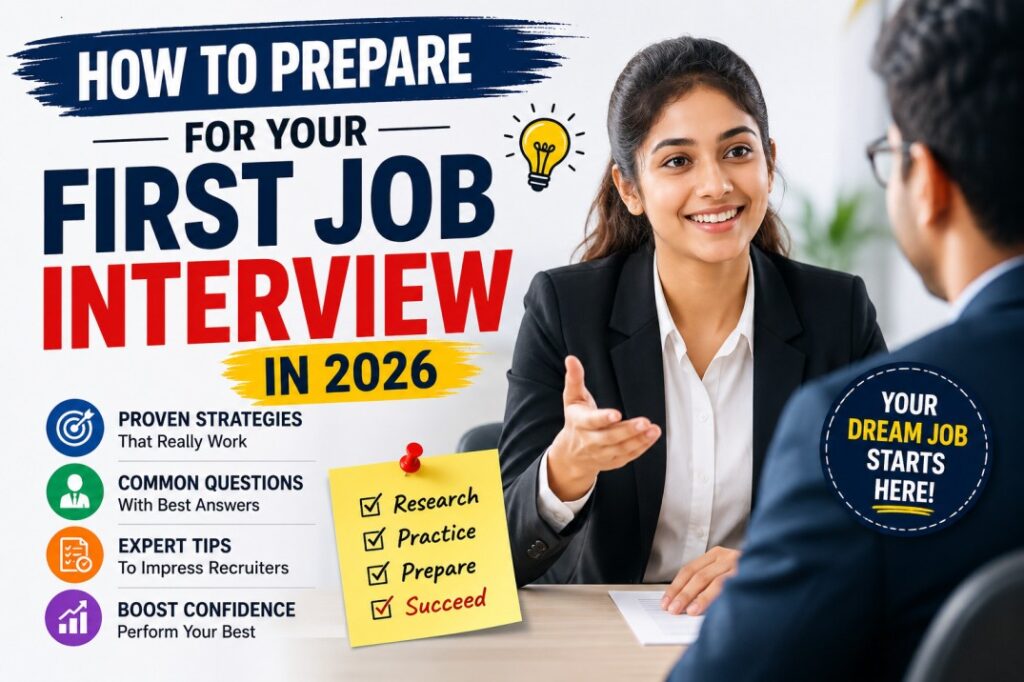
However, for many freshers and first-time job seekers, interviews can feel intimidating. Questions like “What should I say?”, “What if I don’t know the answer?”, and “How can I make a good impression?” often create anxiety.
The good news is that interview success is not about being perfect. It’s about preparation.
In 2026, employers are looking for candidates who demonstrate not only technical skills but also communication, problem-solving abilities, adaptability, and a willingness to learn. Whether your interview is in-person, virtual, or hybrid, proper preparation can significantly improve your confidence and performance.
This guide will walk you through everything you need to know to prepare for your first job interview and maximize your chances of receiving a job offer.
Why Interview Preparation Matters
Many candidates believe interviews are only about answering questions.
In reality, employers use interviews to evaluate:
- Communication skills
- Professional attitude
- Technical knowledge
- Problem-solving abilities
- Cultural fit
- Confidence and personality
A well-prepared candidate stands out because they appear organized, motivated, and genuinely interested in the opportunity.
Even if you lack extensive experience, strong preparation can give you a competitive advantage.
Step 1: Understand the Job Description
Before attending any interview, carefully review the job description.
Pay attention to:
- Required skills
- Responsibilities
- Qualifications
- Preferred experience
- Company expectations
For example, if a Software Developer role mentions:
- Java
- SQL
- Problem-solving
- Team collaboration
Prepare examples that demonstrate your knowledge and experience in these areas.
Many interview questions are directly based on the job description.
Step 2: Research the Company Thoroughly
One of the most common interview mistakes is attending without researching the company.
Interviewers often ask:
“What do you know about our company?”
To answer confidently, research:
Company Overview
- What the company does
- Products and services
- Industry
- Company size
Mission and Values
Understand:
- Company goals
- Work culture
- Core values
Recent News and Updates
Look for:
- New product launches
- Acquisitions
- Awards
- Expansion plans
Social Media Presence
Review:
- Company website
- Career pages
This preparation demonstrates genuine interest and professionalism.
Check Freshers Job Openings: Click here
Step 3: Prepare Your Introduction
Almost every interview begins with:
“Tell me about yourself.”
This is often the most important question because it sets the tone for the entire interview.
A strong answer should include:
Present
Who you are today.
Past
Your education or experience.
Future
Why you’re interested in the position.
Example for Freshers
“Hello, my name is Rahul Sharma. I recently completed my Bachelor’s degree in Computer Science. During my studies, I worked on projects involving Java, SQL, and web development. I enjoy solving technical problems and learning new technologies. I’m excited about this opportunity because it aligns with my skills and career goals, and I believe I can contribute while continuing to grow professionally.”
Keep your introduction between 60 and 90 seconds.
Step 4: Practice Common Interview Questions
Although every interview is different, certain questions appear frequently.
Prepare thoughtful answers for:
HR Interview Questions
- Tell me about yourself.
- Why do you want to work here?
- What are your strengths?
- What are your weaknesses?
- Where do you see yourself in five years?
- Why should we hire you?
Behavioral Questions
Examples:
- Describe a challenge you faced.
- Tell me about a time you worked in a team.
- Explain a situation where you solved a problem.
Use the STAR method:
- Situation
- Task
- Action
- Result
This structure helps you provide clear and organized responses.
Step 5: Review Technical Concepts
For technical positions, employers often assess job-specific knowledge.
Examples include:
Software Development
- Programming languages
- Data structures
- Databases
- APIs
- OOP concepts
Data Analysis
- Excel
- SQL
- Statistics
- Visualization tools
Digital Marketing
- SEO
- Social Media
- Analytics
- Content Strategy
Focus on understanding concepts rather than memorizing answers.
Interviewers appreciate genuine understanding.
Step 6: Prepare Questions for the Interviewer
At the end of most interviews, you will hear:
“Do you have any questions for us?”
Never answer “No.”
Thoughtful questions demonstrate interest and curiosity.
Examples:
- What does success look like in this role?
- What are the biggest challenges facing the team?
- How is performance evaluated?
- What opportunities for learning and development are available?
- What does a typical day look like?
Avoid asking salary-related questions in the first interview unless the interviewer brings it up.
Step 7: Prepare for Virtual Interviews
In 2026, virtual interviews remain common.
Before the interview:
Check Your Technology
Verify:
- Internet connection
- Camera
- Microphone
- Headphones
Choose a Professional Background
Use:
- Clean room
- Neutral background
- Good lighting
Test Video Software
Examples:
- Zoom
- Microsoft Teams
- Google Meet
Join 10–15 minutes early to avoid technical issues.
Step 8: Dress Professionally
Your appearance influences first impressions.
For most professional roles:
Men
- Formal shirt
- Trousers
- Clean shoes
Women
- Professional blouse
- Formal attire
- Minimal accessories
When unsure, slightly overdress rather than underdress.
Even virtual interviews require professional clothing.
Step 9: Practice Mock Interviews
One of the best ways to build confidence is through practice.
Try:
- Mock interviews with friends
- Career center sessions
- Professional mentors
- Online interview simulators
Benefits include:
- Improved confidence
- Better communication
- Reduced nervousness
- More polished answers
The more you practice, the more natural your responses become.
Step 10: Master Body Language
Communication goes beyond words.
Interviewers notice:
Positive Body Language
- Eye contact
- Smiling naturally
- Good posture
- Active listening
Avoid
- Looking distracted
- Slouching
- Fidgeting excessively
- Interrupting the interviewer
Professional body language reflects confidence and maturity.
How to Handle Difficult Questions
Sometimes interviewers ask unexpected questions.
Examples:
- What is your biggest weakness?
- Why are your grades low?
- Why did you leave your previous job?
Be honest and focus on growth.
Example:
“My public speaking skills were initially weak. To improve, I volunteered for presentations and group discussions. Over time, I became much more confident communicating in front of others.”
Employers value self-awareness and continuous improvement.
Common Mistakes to Avoid In Fresher Interview Tips
Many candidates lose opportunities because of avoidable mistakes.
Arriving Late
Always plan to arrive early.
Not Researching the Company
This signals lack of interest.
Memorizing Answers
Interviews should feel like conversations.
Speaking Negatively About Others
Avoid criticizing previous employers, teachers, or colleagues.
Giving One-Word Answers
Provide detailed yet concise responses.
Ignoring Body Language
Non-verbal communication matters.
Forgetting to Ask Questions
Always engage with the interviewer.
Expert Tips For First Job Interview Preparation
Customize Preparation for Every Interview
Study each company separately.
Use Real Examples
Employers trust specific examples more than generic statements.
Focus on Value
Think about how your skills can help the organization.
Prepare Success Stories
Create examples involving:
- Leadership
- Teamwork
- Problem-solving
- Learning experiences
Stay Positive
Employers often hire attitude and potential, especially for entry-level positions.
Follow Up Professionally
Send a thank-you email within 24 hours after the interview.
This small step can leave a positive impression.
Join Career Rise Hub Community
| Join Telegram Channel | Click Here |
| Follow Us On LinkedIn | Click Here |
| Follow Us On Instagram | Click Here |
Check Current Job Openings: Click Here
Quick First Job Interview Preparation Checklist
Before Interview Day:
✅ Review job description
✅ Research company
✅ Prepare introduction
✅ Practice common questions
✅ Review technical concepts
✅ Prepare questions
✅ Test interview setup
✅ Choose professional attire
✅ Print documents if needed
✅ Get adequate sleep
Frequently Asked Questions (FAQ)
How long should I prepare for a job interview?
Ideally, spend several days researching the company, reviewing the job description, and practicing common questions.
What is the most common interview question?
“Tell me about yourself” is one of the most frequently asked interview questions.
How can I reduce interview nervousness?
Practice mock interviews, prepare thoroughly, and focus on having a conversation rather than delivering perfect answers.
What should freshers highlight during interviews?
Freshers should emphasize education, projects, internships, skills, achievements, and willingness to learn.
Is it okay to say “I don’t know” during an interview?
Yes. If you don’t know an answer, be honest and explain how you would approach finding the solution.
What should I wear for a virtual interview?
Dress professionally just as you would for an in-person interview.
How important is body language?
Very important. Positive body language communicates confidence, professionalism, and engagement.
Should I send a thank-you email after an interview?
Yes. A professional thank-you email demonstrates appreciation and professionalism.
Final Thoughts
Your First Job Interview Preparation may feel challenging, but remember that every professional started exactly where you are today.
Interviewers do not expect perfection. They want to see preparation, enthusiasm, honesty, and the potential to grow.
The more effort you invest in researching the company, practicing your responses, and building confidence, the better your performance will be.
Every interview is also a learning opportunity. Even if you don’t receive an offer immediately, the experience helps you improve for future opportunities.
Prepare thoroughly, stay positive, believe in your abilities, and walk into your interview knowing that you are ready to succeed.
Your career journey starts with a single conversation—make it count.