Finding your first job can be challenging, especially if you do not receive a campus placement offer. Many fresh graduates believe that once college placement opportunities are over, their chances of getting hired become significantly lower.
That is not true.
Off-campus hiring gives freshers another path to find entry-level jobs, graduate trainee programs, internships, apprenticeships, and other career opportunities. Companies hire candidates throughout the year through their official career pages, job portals, LinkedIn, employee referrals, recruitment drives, internship programs, and other recruitment channels.
However, finding off-campus jobs requires a more structured approach.
The biggest mistake many freshers make is searching for random job posts and applying to everything they see. A better strategy is to identify relevant roles, prepare a strong resume, use reliable job sources, track applications, build relevant skills, and prepare for assessments and interviews.
This guide explains how to find off-campus jobs for freshers in 2026, where to search, how to apply effectively, how to avoid fake job offers, and what to do when you are not receiving interview calls.
What Are Off-Campus Jobs?
Off-campus jobs are employment opportunities that candidates apply for independently rather than through their college’s official campus placement process.
For example, you may find an opportunity through:
- A company’s official careers page
- A job portal
- An employee referral
- A recruitment drive
- An internship that converts into a full-time role
- An apprenticeship program
- A professional network
- A government employment platform
Unlike campus placements, your college may not manage the application or selection process.
You are generally responsible for finding the opportunity, checking eligibility, submitting your application, preparing for assessments, and attending interviews.
Why Should Freshers Look for Off-Campus Jobs?
Off-campus hiring gives freshers access to opportunities beyond the companies visiting their college.
This can be useful if:
- Your college has limited placement opportunities.
- You did not receive a campus placement offer.
- You want to explore companies outside your campus recruitment list.
- You are targeting a specific role or industry.
- You want to change your career direction.
- You graduated without participating in campus placements.
- You want to apply to companies throughout the year.
Your college placement process and off-campus job search do not have to be treated as completely separate options.
If you are still eligible for campus placements, you can continue participating while also exploring relevant off-campus opportunities, subject to your college’s placement policies.
Who Can Apply for Off-Campus Jobs?
Eligibility depends entirely on the company and role.
Off-campus opportunities may be available to:
- Final-year students
- Recent graduates
- Freshers
- Candidates with 0–1 years of experience
- Candidates with 0–2 years of experience
- Diploma holders
- Engineering graduates
- Science graduates
- Commerce graduates
- MBA graduates
- Candidates returning to the job market
Always read the eligibility criteria carefully.
Check:
- Graduation year
- Degree or specialization
- Minimum academic requirements
- Backlog criteria
- Location requirements
- Experience requirements
- Work authorization requirements
- Required skills
Do not assume that every position labelled “fresher” has the same eligibility criteria.
Check Off-Campus Jobs: Click here
Step 1: Decide Which Roles You Want to Target
Before searching for off-campus jobs, identify the roles that match your education and skills.
For example, a Computer Science or IT graduate might target:
- Associate Software Engineer
- Software Developer Trainee
- Java Developer
- Python Developer
- QA Engineer
- Test Engineer
- Technical Support Engineer
- Data Analyst
- Cloud Support Associate
A Mechanical Engineering graduate might search for:
- Graduate Engineer Trainee
- Design Engineer
- Production Engineer
- Quality Engineer
- Manufacturing Engineer
- Maintenance Engineer
A commerce or business graduate might target:
- Business Analyst
- Operations Executive
- Finance Associate
- Accounts Executive
- Customer Support Executive
- Sales Executive
Do not limit yourself to a single job title.
Instead, create a list of approximately 5–10 relevant entry-level job titles.
This makes your search more focused while still giving you access to a wider range of opportunities.
Step 2: Prepare a Strong Fresher Resume
Your resume is one of the first things a recruiter may review.
Before applying for off-campus jobs, make sure your resume clearly presents:
- Education
- Relevant technical or professional skills
- Academic projects
- Personal projects
- Internships
- Certifications
- Achievements
- Relevant extracurricular activities
For most freshers, a focused one-page resume is a practical starting point.
Your resume should be customized around the type of roles you are targeting.
For example, if you are applying for software development roles, prioritize:
- Programming languages
- Data structures and algorithms
- Databases
- Projects
- Development tools
If you are applying for data analyst roles, prioritize:
- Excel
- SQL
- Python
- Power BI or other relevant tools
- Data analysis projects
Avoid creating one resume containing every technology or skill you have ever encountered.
For a detailed guide, internally link to your article:
How to Write a Fresher Resume With No Experience in 2026
You can also link to:
Best Resume Skills for Freshers in 2026
and:
How to Create an ATS-Friendly Resume in 2026
Step 3: Search on Official Company Career Pages
One of the most reliable ways to find off-campus jobs is through official company career pages.
Many companies publish job openings directly on their own websites.
Create a list of companies you are interested in and check their careers pages regularly.
For example, organize your list by industry:
IT and Technology
Look for:
- Graduate programs
- Associate roles
- Entry-level software jobs
- Support roles
- Internship opportunities
Manufacturing and Engineering
Look for:
- Graduate Engineer Trainee programs
- Design roles
- Production roles
- Quality positions
- Manufacturing opportunities
Banking and Financial Services
Look for:
- Graduate programs
- Operations roles
- Analyst positions
- Customer support roles
- Technology positions
Consulting and Business Services
Look for:
- Analyst roles
- Associate positions
- Graduate programs
- Operations opportunities
Official career pages can help you verify:
- Whether the job is genuine
- The complete job description
- Eligibility requirements
- Application deadlines
- Location
- Required skills
Whenever you discover a job through social media or a third-party job portal, it can be useful to check whether the same opening appears on the company’s official careers page.
Step 4: Use LinkedIn for Off-Campus Job Search
LinkedIn can be useful for discovering entry-level opportunities, following companies, and building professional connections.
Search using specific job titles rather than only searching for “fresher jobs.”
Try searches such as:
- Associate Software Engineer
- Software Developer Trainee
- Graduate Engineer Trainee
- Entry-Level Data Analyst
- QA Engineer Fresher
- Junior Java Developer
- Mechanical Design Engineer Fresher
Use relevant filters such as:
- Location
- Experience level
- Date posted
- Employment type
- Work mode
You can also follow companies that regularly hire freshers.
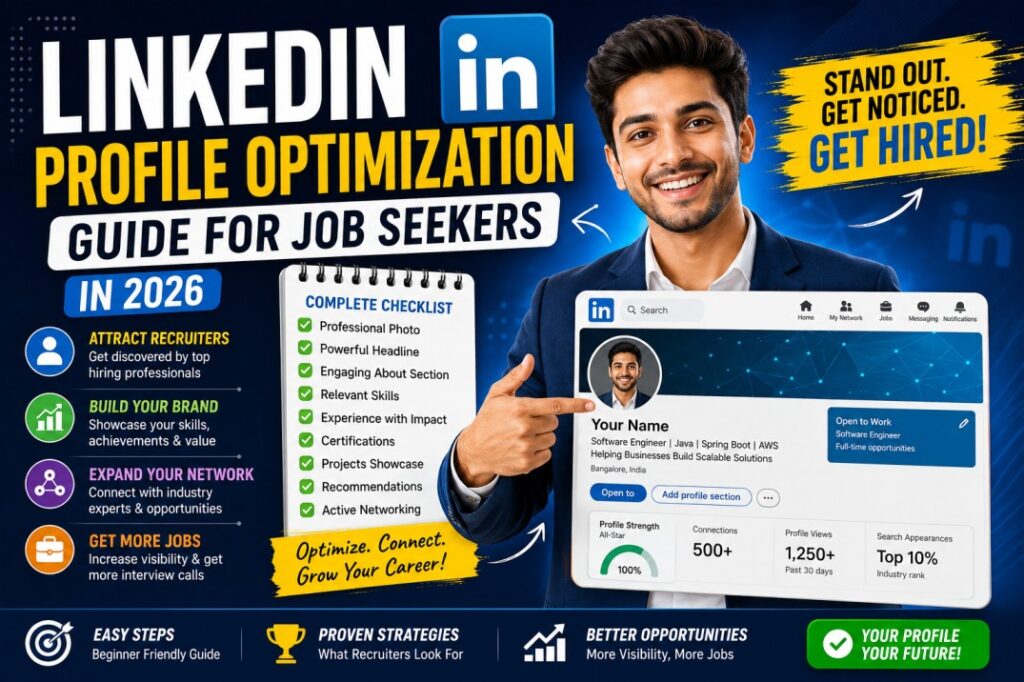
A complete LinkedIn profile can support your job search by helping recruiters and professionals understand your:
- Educational background
- Skills
- Projects
- Internships
- Certifications
- Career interests
For additional guidance, internally link to your LinkedIn Profile Optimization Guide for Job Seekers.
Step 5: Set Up Job Alerts
Job alerts can help you discover new opportunities without manually repeating the same searches every day.
Create alerts for your most important job titles.
For example:
- Graduate Engineer Trainee
- Associate Software Engineer
- Software Developer Fresher
- Data Analyst Entry Level
- Java Developer 0–1 Years
- Mechanical Design Engineer Fresher
Avoid creating alerts for dozens of unrelated roles.
A focused set of alerts makes it easier to review opportunities and avoid becoming overwhelmed.
When you receive an alert, review the job description before applying.
Step 6: Use Reputable Job Portals
Job portals can provide access to a large number of off-campus opportunities.
However, your search strategy matters.
Instead of searching:
Jobs for Freshers
use specific search combinations.
Examples:
- Java Developer Fresher Pune
- Graduate Engineer Trainee Mechanical
- Entry-Level Data Analyst
- QA Engineer 0–1 Years
- Software Developer Trainee
- Junior Business Analyst
You can also try keywords commonly used in entry-level hiring:
- Fresher
- Graduate
- Trainee
- Associate
- Junior
- Entry Level
- 0–1 Years
- Graduate Engineer
- Management Trainee
Review each job description carefully before applying.
Step 7: Use Government Employment Services
Freshers in India can also explore government-supported employment platforms.
The National Career Service provides job-search functionality where candidates can search using factors such as:
- Keywords
- Location
- Sector
- Functional area
- Education
- Experience
- Job nature
NCS also states that its employment-related services are free and warns candidates to remain alert to fraudulent entities claiming an association with the platform.
When using any employment platform, verify the employer and recruitment process before sharing unnecessary personal or financial information.
Step 8: Follow Graduate Hiring Programs
Many companies hire fresh graduates through dedicated programs.
These programs may use names such as:
- Graduate Program
- Graduate Trainee
- Graduate Engineer Trainee
- Management Trainee
- Campus Hiring
- Early Careers
- University Hiring
- Associate Program
- Entry-Level Program
Do not search only for the word “fresher.”
Searching for these additional terms may help you find opportunities that are intended for recent graduates.
Step 9: Search for Off-Campus Recruitment Drives
Companies may conduct recruitment drives for multiple candidates.
These may be:
- Walk-in drives
- Virtual hiring drives
- Open recruitment events
- Assessment drives
- Graduate recruitment campaigns
Before attending or registering, verify:
- Company name
- Location
- Official communication source
- Eligibility
- Date and time
- Required documents
- Recruitment process
Be cautious if an unofficial organizer asks candidates to pay money to participate.
Step 10: Use Employee Referrals
Employee referrals can be another way to discover relevant opportunities.
You may find professionals through:
- College alumni networks
- Previous internship contacts
- Friends
- Professional communities
When asking for a referral, be specific.
Avoid messages such as:
“Hi, please refer me for any job in your company.”
A better approach is:
“Hi, I recently completed my degree in Computer Engineering and noticed an Associate Software Engineer opening at your company. My background includes Java, SQL, and academic projects in web development. If you are comfortable referring me for this specific role, I would be grateful. I can share my resume and the job link.”
A referral does not guarantee selection, so continue preparing and applying independently.
Step 11: Use Your College Alumni Network
Your alumni network can be particularly valuable during an off-campus job search.
Look for alumni who work in:
- Companies you are targeting
- Industries you are interested in
- Roles similar to your career goals
You can ask for:
- Guidance about the hiring process
- Information about relevant skills
- Advice on preparing for interviews
- Information about open positions
Build professional relationships rather than contacting people only to request referrals.
Step 12: Explore Internships That Can Lead to Full-Time Roles
If you are not receiving full-time offers, a relevant internship can help you build practical experience.
An internship may help you develop:
- Technical knowledge
- Workplace communication
- Team collaboration
- Project experience
- Industry understanding
Some organizations may convert successful interns into full-time employees, although this is never guaranteed unless explicitly stated.
Before accepting an internship, understand:
- Duration
- Stipend
- Responsibilities
- Learning opportunities
- Working arrangements
- Possibility of full-time conversion
A relevant internship can also strengthen your future off-campus applications.
Step 13: Explore Apprenticeship Opportunities
Apprenticeships can provide practical workplace experience, especially for candidates in technical, engineering, manufacturing, and vocational fields.
Before applying, check:
- Eligibility
- Employer
- Duration
- Stipend
- Training structure
- Location
- Employment terms
Do not assume that completing an apprenticeship automatically guarantees a permanent position.
Instead, evaluate whether the experience will help you build relevant skills.
Step 14: Join Relevant Professional Communities
Professional communities can sometimes help you discover opportunities before they become widely visible.
However, do not blindly trust every job post shared in:
- WhatsApp groups
- Telegram channels
- Facebook groups
- Discord communities
- Other social media groups
Use communities to discover opportunities, but verify the original source.
Before applying, check:
- Is the company legitimate?
- Does the opening exist on an official company source?
- Is the recruiter using a legitimate business email?
- Is anyone asking for payment?
- Does the recruitment process sound realistic?
Never treat a social media post alone as proof that a job is genuine.
Step 15: Search Using Google More Effectively
Search engines can also help you find career pages and official job listings.
Try searches such as:
Company Name careers graduate jobs
Company Name careers fresher software engineer
Graduate engineer trainee jobs 2026
Associate software engineer fresher careers
You can also search for specific company hiring pages.
For example:
Company Name careers India
This can be more effective than repeatedly searching only for “fresher jobs.”
Always verify that you are visiting the genuine company website.
Step 16: Create a Target Company List
Instead of searching randomly every day, create a list of companies you want to monitor.
Your spreadsheet could include:
| Company | Industry | Target Role | Careers Page | Status | Last Checked |
|---|---|---|---|---|---|
| Company A | IT | Software Developer | Saved | No Opening | |
| Company B | Manufacturing | GET | Saved | Applied | |
| Company C | Analytics | Data Analyst | Saved | Interview |
A target company list helps you build a systematic job-search process.
You can include:
- Dream companies
- Mid-sized companies
- Startups
- Local companies
- Multinational organizations
- Growing companies in your target industry
Do not focus only on famous companies.
Smaller and mid-sized organizations may also offer valuable entry-level experience.
Step 17: Create a Job Application Tracker
Once you start applying, track your applications.
A simple spreadsheet can include:
| Company | Role | Source | Date Applied | Status | Next Action |
| Company A | GET | Careers Page | Applied | Wait | |
| Company B | Java Developer | Assessment | Prepare | ||
| Company C | QA Engineer | Referral | Interview | Practice |
This can help you track:
- Applications
- Assessment dates
- Interview schedules
- Follow-ups
- Rejections
- Offers
It also helps you identify which job sources are generating the most interview opportunities.
Step 18: Customize Your Resume for Important Applications
A single resume may not be ideal for every role.
You do not need to redesign your entire resume for every application, but you can adjust important sections.
For example, if you are applying for a Java developer role, prioritize:
- Java
- OOP
- SQL
- Relevant projects
- APIs
- Development tools
For a data analyst role, prioritize:
- SQL
- Excel
- Power BI
- Python
- Data analysis projects
This helps recruiters quickly understand how your background relates to the role.
Use keywords naturally.
Do not copy a job description into your resume.
Step 19: Build Projects While Searching for Jobs
Do not spend all your time applying.
If you are not currently employed, use part of your job-search period to strengthen your profile.
A software fresher could build:
- Portfolio website
- Expense tracker
- Student management system
- E-commerce project
- REST API
- Data analysis application
A data candidate could create:
- Excel dashboard
- SQL analysis project
- Power BI dashboard
- Python data analysis project
An engineering fresher could work on:
- CAD models
- Product design concepts
- Technical case studies
- Manufacturing analysis
- Engineering simulations
A good project gives you something practical to discuss in an interview.
Step 20: Prepare for Online Assessments
Many off-campus recruitment processes begin with an online assessment.
Depending on the role, this may include:
- Quantitative aptitude
- Logical reasoning
- Verbal ability
- Technical questions
- Coding problems
- SQL questions
- Domain-specific questions
Do not wait until you receive an assessment invitation.
Create a regular preparation routine.
For example:
- 30 minutes of aptitude practice
- 30 minutes of technical revision
- 30–60 minutes of coding or skill development
Internally link here to your relevant Aptitude Questions and Answers article.
Step 21: Prepare for Technical Interviews
Your technical preparation should match your target role.
For software development roles, you may need to prepare:
- Programming fundamentals
- OOP
- Data structures
- Algorithms
- DBMS
- SQL
- Operating systems
- Computer networks
For data analyst roles, focus on:
- SQL
- Excel
- Data analysis
- Data visualization
- Statistics fundamentals
- Relevant projects
For mechanical engineering roles, preparation may include:
- Core engineering subjects
- Manufacturing
- Design
- Materials
- Thermodynamics
- Engineering drawings
Your resume should guide your preparation.
Anything you mention on your resume may be discussed during an interview.
Step 22: Prepare for HR Interviews
Off-campus hiring often includes HR or behavioral interview rounds.
Prepare answers for questions such as:
- Tell me about yourself.
- Why do you want to join our company?
- Why should we hire you?
- What are your strengths?
- What is your weakness?
- Why are you looking for this role?
- Are you willing to relocate?
- Where do you see yourself in five years?
Avoid memorizing answers word for word.
Instead, prepare key points and practice explaining them naturally.
Internally link to your First Job Interview Preparation Guide or related interview articles.
Step 23: Follow Up Professionally
If you have completed an interview or assessment, follow the company’s stated communication process.
If no timeline is provided, a polite follow-up may be appropriate.
Keep the message short and professional.
Avoid:
- Repeated daily messages
- Calling recruiters unnecessarily
- Sending multiple messages through different platforms
- Demanding an immediate response
Professional communication matters throughout the recruitment process.
Step 24: Learn How to Identify Fake Off-Campus Jobs
Freshers should be particularly careful about job scams.
Warning signs can include:
- A demand for registration fees
- Requests for security deposits
- Payment requests before joining
- Guaranteed job offers for a fee
- Unofficial email addresses
- Poorly written offer letters
- Pressure to make an immediate payment
- Unrealistic salary promises
- Requests for unnecessary financial information
A genuine job offer should be verified through official company communication.
If you receive a suspicious offer, visit the company’s official website and use official contact channels to verify the recruitment process.
Step 25: Never Pay Money for a Guaranteed Job
Be cautious of anyone who says:
- “Pay this amount to confirm your job.”
- “Pay registration charges.”
- “Pay a processing fee for the offer letter.”
- “Pay for mandatory training before selection.”
- “We guarantee placement after payment.”
A job search should not involve paying an unknown individual simply because they promise employment.
Always investigate before making any payment or sharing sensitive documents.
Step 26: Do Not Apply Randomly to Every Opening
A common mistake is sending hundreds of identical applications.
A better approach is to focus on relevant opportunities.
Before applying, ask:
- Am I eligible?
- Does this role match my skills?
- Can I explain my projects during the interview?
- Is the company genuine?
- Is the application source trustworthy?
- Does the location work for me?
Quality applications are generally more useful than a large number of completely unrelated applications.
How Many Off-Campus Jobs Should Freshers Apply for Every Day?
There is no fixed number that guarantees a job.
Instead of setting an unrealistic target, build a sustainable routine.
For example, you might:
- Search for new opportunities daily.
- Review 5–10 relevant openings.
- Apply to the strongest matches.
- Customize your resume for important roles.
- Continue skill development.
- Prepare for assessments and interviews.
The goal is consistency.
Ten relevant applications completed carefully can be more useful than 100 random applications.
What to Do If You Are Not Getting Interview Calls
If you have applied to many off-campus jobs but are not receiving responses, review your strategy.
Review Your Resume
Ask:
- Is my target role clear?
- Are my relevant skills visible?
- Are my projects described properly?
- Is the resume easy to read?
- Does it contain unnecessary information?
Review Your Target Roles
Make sure you are applying for positions that match your current skills and eligibility.
Improve Your Skills
Look at several relevant job descriptions.
Are the same skills appearing repeatedly?
If those skills are important for your career path, consider learning them and building practical projects.
Improve Your LinkedIn Profile
Make your headline, skills, projects, and career interests clear.
Improve Your Application Sources
Track where your applications come from.
You may discover that certain sources generate better results.
Review Your Interview Preparation
If you are receiving interviews but not receiving offers, focus on improving your technical and communication preparation.
A 30-Day Off-Campus Job Search Plan for Freshers
A structured plan can help you avoid spending weeks applying without improving your profile.
Week 1: Build Your Job-Search Foundation
Focus on:
- Creating an ATS-friendly resume.
- Identifying target roles.
- Updating LinkedIn.
- Preparing project descriptions.
- Creating a target company list.
- Setting up a job application tracker.
Week 2: Start Targeted Applications
Focus on:
- Official company career pages.
- LinkedIn jobs.
- Relevant job portals.
- Graduate hiring programs.
- Internship and apprenticeship opportunities.
- Alumni connections.
Week 3: Improve Skills and Interview Preparation
Focus on:
- Technical fundamentals.
- Aptitude practice.
- Project development.
- Common interview questions.
- Resume-based questions.
Continue applying to relevant opportunities.
Week 4: Analyze and Improve
Review:
- Number of applications submitted.
- Interview calls received.
- Assessments received.
- Rejections.
- Skills repeatedly requested by employers.
- Application sources that worked best.
Then adjust your strategy.
If you are not getting interview calls, improve your resume and targeting.
If you are failing assessments, improve your aptitude or technical preparation.
If you are reaching interviews but not receiving offers, improve your interview skills.
A Daily Routine for Finding Off-Campus Jobs
A simple routine could include:
30 minutes: Search for new job opportunities.
30–60 minutes: Review job descriptions and submit targeted applications.
30 minutes: Update LinkedIn, portfolio, or application tracker.
60 minutes: Technical skill development or aptitude preparation.
30 minutes: Work on a relevant project.
You do not need to follow this exact schedule.
The important thing is to balance:
Job Search + Applications + Skill Development + Interview Preparation
Common Off-Campus Job Search Mistakes Freshers Should Avoid
Depending Only on Job Portals
Use multiple sources, including company career pages and professional networks.
Applying Without Reading Eligibility Criteria
This wastes time and may lead to unnecessary applications.
Using the Same Resume for Every Role
Customize important applications.
Ignoring Smaller Companies
Mid-sized companies and startups may also provide valuable opportunities.
Applying Only to Famous Companies
Competition can be extremely high. Maintain a balanced company list.
Not Tracking Applications
Without a tracker, you may miss assessment or interview deadlines.
Ignoring Your LinkedIn Profile
Recruiters and professionals may review it after seeing your application.
Stopping Skill Development
Continue improving while searching.
Trusting Every Social Media Job Post
Verify the original source.
Paying Money for Job Offers
Be extremely cautious about payment requests.
Giving Up Too Early
The first job search often requires persistence and continuous improvement.
Off-Campus Job Search Checklist for Freshers
Before applying, make sure you have:
- A professional resume.
- A clear target role.
- Relevant technical or professional skills.
- At least one or two projects.
- An updated LinkedIn profile.
- A professional email address.
- A target company list.
- Job alerts.
- An application tracker.
- Basic aptitude preparation.
- Interview preparation.
For every job application:
- Read the complete job description.
- Check eligibility.
- Verify the company.
- Use relevant keywords naturally.
- Customize important applications.
- Record the application.
- Prepare for the next stage.
Join Career Rise Hub Community
| Join Telegram Channel | Click Here |
| Follow Us On LinkedIn | Click Here |
| Follow Us On Instagram | Click Here |
Check Current Job Openings: Click here
Frequently Asked Questions About Off-Campus Jobs for Freshers
How can freshers find off-campus jobs in 2026?
Freshers can find off-campus jobs through official company career pages, LinkedIn, job portals, employee referrals, alumni networks, graduate hiring programs, recruitment drives, internships, apprenticeships, and government employment services.
Are off-campus jobs available for freshers?
Yes. Many companies hire recent graduates for entry-level, trainee, associate, graduate engineer, internship, and early-career positions.
Which websites are best for finding off-campus jobs?
The most useful approach is to combine official company career pages with professional networking platforms, established job portals, and government employment services. Always verify the original employer and job listing before applying.
Should I apply through a company’s official career page?
Yes, when possible. Official career pages can help you verify that an opening is genuine and provide the most accurate information about eligibility and the application process.
How can I get an off-campus job without experience?
Freshers can demonstrate their abilities through academic projects, personal projects, internships, certifications, skills, and relevant college activities. Focus on entry-level positions that match your current qualifications.
How many off-campus jobs should I apply for?
There is no guaranteed number. Focus on consistent, relevant applications rather than applying randomly to every opening.
Is LinkedIn useful for finding off-campus jobs?
Yes. LinkedIn can help freshers discover opportunities, follow companies, connect with professionals, and build a professional profile.
Can employee referrals help freshers?
Employee referrals may help your application reach the relevant recruitment process, but they do not guarantee selection. You still need to meet eligibility requirements and clear the company’s selection process.
How can I avoid fake off-campus job offers?
Verify the company and job through official sources, check recruiter email addresses, avoid suspicious payment requests, and be cautious about guaranteed job offers.
Should I accept an internship if I cannot find a full-time job?
A relevant internship can help you gain practical experience and strengthen your resume. Evaluate the responsibilities, learning opportunities, employer, and terms before accepting.
Final Thoughts
Finding off-campus jobs as a fresher in 2026 requires more than searching for the phrase “fresher jobs” every day.
A successful off-campus job search is usually built around a simple process:
- Identify your target roles.
- Build a strong and relevant resume.
- Optimize your LinkedIn profile.
- Search official company career pages.
- Use job portals strategically.
- Set up targeted job alerts.
- Build professional connections.
- Track every application.
- Continue improving your skills.
- Prepare for assessments and interviews.
- Verify every opportunity before sharing information or accepting an offer.
Do not depend on a single job portal or wait for one company to respond.
Build a consistent process and use multiple reliable sources.
Your first job search may take time, and rejection is a normal part of the process. Instead of applying blindly, review your results regularly and improve the part of your strategy that needs attention.
The goal is not simply to get any job.
The goal is to find a genuine entry-level opportunity where you can gain experience, develop relevant skills, and take the next step in your career.